
FOB Rate Calculator Explained: Formula, Example & Free Tool for Garment Merchandisers
If you work in garment merchandising, you already know that one wrong number in your FOB calculation can turn a profitable order into a loss-making one. Buyers negotiate hard, margins are thin, and every cost head — from fabric to freight — has to be accounted for before you quote a price.
This is exactly why an accurate FOB rate calculator is one of the most important tools a garment merchandiser can have. In this article, we’ll break down what FOB really means in apparel export, walk through the FOB calculation formula with a real example, and show how a modern garment ERP software can automate this entire process.
What Does FOB Mean in Garment Export?
FOB stands for Free on Board. It is an international shipping term (part of Incoterms) that defines the point at which the responsibility, cost, and risk of goods transfer from the seller (exporter/manufacturer) to the buyer (importer).
In simple terms: under FOB shipment terms, the manufacturer’s responsibility ends once the goods are loaded onto the shipping vessel at the port of origin. From that point, the buyer takes over costs like ocean freight, marine insurance, and destination charges.
This is different from other common terms:
- FOB (Free on Board): Seller pays until goods are loaded on the ship.
- CIF (Cost, Insurance, Freight): Seller also pays freight and insurance to the destination port.
- EXW (Ex Works): Buyer takes responsibility right from the factory gate.
Understanding FOB delivery meaning correctly is critical because it directly changes which costs go into your quoted price.
Why Garment Merchandisers Need an Accurate FOB Value Calculator
A garment merchandiser is responsible for costing every style before it’s quoted to a buyer. If the FOB value calculator used is inaccurate or based on outdated Excel sheets, it can lead to:
- Underquoting and shrinking margins
- Overquoting and losing orders to competitors
- Disputes with buyers over cost breakdowns
- Delays in sample and order confirmation
Getting your FOB calculation formula right, every single time, is what separates a reliable merchandising team from one that’s constantly firefighting.
FOB Calculation Formula for Garments
At its core, the FOB calculation formula adds up all costs incurred until the goods are loaded on board, plus your profit margin. A simplified structure looks like this:
FOB = (Fabric Cost + Trims & Accessories Cost + CM (Cost of Making) + Other Overheads + Commission + Profit Margin)
Let’s break each component down:
- Fabric Cost – Fabric consumption per garment × fabric price per unit
- Trims & Accessories Cost – Buttons, zippers, labels, packing material, etc.
- CM (Cost of Making) – Also called “Cut & Make” cost, this covers cutting, sewing, finishing, and factory overheads per piece
- Other Overheads – Testing, inspection, compliance, and admin costs
- Commission – Buying house or agent commission, if applicable
- Profit Margin – The manufacturer’s markup
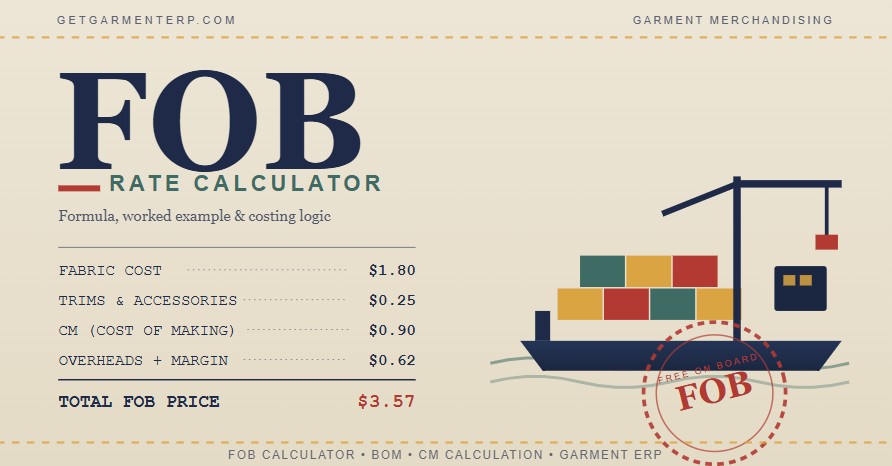
FOB Calculation Example
Let’s say you’re costing a basic cotton T-shirt:
| Cost Head | Amount (USD) |
|---|---|
| Fabric Cost | $1.80 |
| Trims & Accessories | $0.25 |
| CM (Cost of Making) | $0.90 |
| Overheads (testing, admin) | $0.15 |
| Commission (5%) | $0.15 |
| Profit Margin (10%) | $0.32 |
| Total FOB Price | $3.57 |
This is a simplified FOB calculation example — in reality, merchandisers also factor in wastage percentages, exchange rate fluctuations, and MOQ-based fabric pricing, which is where manual Excel-based costing starts to break down.
CM Calculation: The Most Sensitive Part of FOB Costing
CM Calculation (Cost of Making) is often the trickiest part of the FOB formula because it depends on:
- Style complexity (number of operations/SAM value)
- Machine and labor rate per minute
- Factory efficiency percentage
- Order quantity
A small error in SAM (Standard Allowed Minutes) or efficiency assumption can shift your CM — and therefore your FOB — by 5-10%. This is a major reason garment factories are moving away from manual spreadsheets toward dedicated garment costing software.
From Manual Excel Sheets to Garment ERP Software
Most factories start with Excel-based FOB calculators. They work, until:
- Multiple merchandisers use different versions of the same sheet
- Fabric/trim prices change and don’t get updated everywhere
- There’s no link between costing, BOM (Bill of Materials), and actual production data
- Buyers ask for instant cost breakdowns and revisions
This is where a purpose-built garment ERP software makes a real difference. A good apparel costing software module inside an ERP allows you to:
- Auto-pull fabric and trim rates from your BOM
- Apply CM rates based on style complexity and SAM
- Instantly recalculate FOB when any cost head changes
- Maintain a single source of truth across merchandising, production, and finance teams
- Generate buyer-ready cost sheets in minutes, not hours
BOM and FOB: Why They Should Be Connected
Your BOM (Bill of Materials) lists every fabric, trim, and accessory needed for a style along with quantities. Your FOB calculation should pull directly from this BOM rather than being built separately — otherwise, any change in consumption or trim price won’t reflect in your final costing.
This is one of the biggest advantages of an online garment costing system: BOM, costing, and FOB are connected in real time, so your merchandising team is always quoting with current, accurate numbers.
Choosing the Right Garment Costing Software
If you’re evaluating garment costing software or looking for a garment ERP alternative to your current manual process, look for these must-have features:
- FOB, CM, and BOM calculation in one connected workflow
- Support for multiple costing methods (FOB, CIF, EXW)
- Version control for cost sheets and revisions
- Multi-currency support for exchange rate changes
- Easy sharing of buyer-ready cost sheets
- Integration with production and inventory data
Final Thoughts
An accurate FOB rate calculator isn’t just a costing tool — it’s the foundation of profitable garment merchandising. Whether you’re calculating a simple FOB shipment for a basic style or a complex multi-component garment, getting your fabric cost, CM calculation, and overheads right is what protects your margins.
If your team is still relying on scattered Excel sheets for FOB and BOM calculations, it may be time to explore a dedicated garment manufacturing ERP that brings costing, BOM, and production together in one place.
Want to see how automated FOB and BOM costing works in practice? Explore GetGarmentERP and see how garment manufacturers are simplifying their costing and merchandising workflows.